
Resource Center

Clear Measure provides resources to empower software leaders and developers in software delivery, fulfilling our vision to improve and inspire software teams worldwide.

One of our clients was spending five full days on every manual deployment — not because they lacked talent, but because their Octopus Deploy environment had never been properly assessed or updated since it was first stood up years earlier. Tentacles (Octopus's deployment agents) had accumulated. Integrations had drifted. And nobody had stopped long enough to ask whether any of it still made sense. If that sounds familiar, you're not alone. Aging, unexamined Octopus Deploy environments are one of the most consistent problems we see across enterprise teams in healthcare, financial services, insurance, energy, and beyond.

Here's how we help teams fix that — and what's possible on the other side.

 Phase I: Assessing Your Octopus Deploy Environment Before Migration When a client comes to us with an aging Octopus Deploy environment, we don't start by recommending an immediate upgrade. We start by looking carefully at what is already there. Our Octopus Deploy Migration Planning engagement — designed specifically for complex environments — gives teams a complete picture before a single migration step is taken. This includes:
  • Analysis of the existing Octopus Deploy instance — what version, what configuration, what integrations, what's working and what's fragile
  • Analysis of the software being deployed and the nature of the environments being deployed to (cloud, hybrid, on-prem)
  • Sequencing of major migration or upgrade steps so nothing falls through the cracks
  • Best practices recommendations tailored to your architecture
In Phase I, our team conducts a thorough technical analysis of the client's Octopus Deploy environment, assesses and prioritizes their existing application portfolio across multiple environments, evaluates future applications as candidates for migration, and produces a formal migration plan with documented steps and a timeline. Trying to determine whether to stay on-prem or move to the cloud? We will uncover the information you need to make a confident decision. The output of Phase I isn't just a document — it's the strategic foundation that makes Phase II possible without unnecessary risk. Phase II: Proof of Concept for Your Octopus Deploy Migration With the migration plan from Phase I, we move into Phase II: Proof of Concept Implementation. Rather than attempting a full migration all at once, we use the POC approach to validate assumptions, surface any environment-specific surprises, and demonstrate end-to-end success for one application before scaling. This single-application migration serves as the proving ground — testing the target Octopus Deploy environment setup, validating deployment pipelines, and building client team confidence in the approach. A well-run POC de-risks the broader migration, gives stakeholders something concrete to evaluate, and creates a replicable pattern your team can follow for every subsequent application. Phase III: Full Portfolio Migration with Octopus Deploy

Following Phases I and II, you'll have something most teams never start with: a validated migration pattern, a target environment that's been proven to work, and a team that has already done this once successfully. That changes everything about how the remaining portfolio gets migrated.

At that point, we'll present a full estimate for converting the remainder of your applications to Octopus Deploy. From there, you have options. Our team can execute the full migration on your behalf, or your team can take on the work directly with our experts advising alongside them. What doesn't change regardless of the path: your team will understand exactly how the work is done, with detailed documentation and hands-on advisement until they're fully confident managing the environment on their own.

Octopus Deploy Training: Up-Leveling Your Team for Long-Term Success

Deploying a new version of Octopus is only as valuable as your team's ability to use it well. That's why team enablement is built into every Clear Measure engagement — not treated as an afterthought.

We meet teams where they are. If your team is new to Octopus or needs to reset some ingrained habits, a focused 2-hour orientation gets everyone aligned quickly. For organizations ready to go deeper, a full day of platform engineering planning helps connect architecture decisions to long-term delivery goals. And for enterprise teams looking to build advanced expertise and deploy at scale, we offer pro-level training customized to your environment and roadmap.

As Clear Measure Chief Architect Jeffrey Palermo puts it:
"There isn't anything Octopus can't deploy. But if automated DevOps is new to your team, make sure to plan your platform engineering properly. Empower your team to establish quality, achieve stability, and increase speed of delivery."
Learn more about how we work with Octopus Deploy across industries and team sizes. What Our Clients Are Saying
"It was taking our team five days to do a proper manual deployment, so I decided it was time to move automation to the next level. By increasing the utilization of Octopus Deploys automation features from 10% to 80%, the company has increased productivity by over 84%. Now we have more efficiency and accuracy. It's a completely different deployment experience." — SVP of Operations, Alphapoint "Our old method of deployments was cumbersome on our IT team, and required significant time and stress. Clear Measure helped us set up an Octopus Deploy configuration that allows us to initiate mid-day deployments, saving time we would have normally spent after-hours to do a deployment." — Frontier
How Octopus Deploy Fits Into a Modern AI DevOps Architecture Upgrading Octopus Deploy is one piece of a larger picture. At Clear Measure, we view deployment tooling as a core component of a modern AI DevOps architecture: the interconnected system of pipelines, automation, feedback loops, and intelligence that allows engineering teams to deliver software reliably and rapidly.

When your Octopus Deploy instance is current, properly configured, and correctly integrated with your build servers and cloud environments, it becomes the foundation that makes AI-assisted delivery possible — automated validation, complete auditability, and the kind of deployment speed that lets engineers focus on architecture and innovation instead of firefighting. Without that foundation, even the best AI tooling has nothing reliable to build on.

To see what this looks like end-to-end, download our AI DevOps Architecture Poster — a print-ready reference designed for .NET and Azure engineering teams. Octopus Deploy Migration Results: Real Client Outcomes The numbers speak for themselves. In one engagement with a FinTech firm, new environments that previously took days to provision were up and running in 4 hours or less, features could be deployed on demand, and overall team productivity increased by 84%. Read the full case study: Optimized DevOps Roadmap to Deliver Faster Results In another engagement, a supply chain management company with over 200 employees eliminated tedious manual deployments entirely — gaining the flexibility to deploy mid-day without disruption, proactively catching errors before they reached production, and freeing their IT team from the after-hours grind that had become the norm. Read the full case study: Streamline Deployments and Reduce Cycle Time Both transformations started with the same foundational work — assessing what existed, planning the right path forward, and proving it out before scaling. The pattern holds across every industry we work in:
  1. Inspect the existing environment with honesty and rigor
  2. Plan the migration before touching anything
  3. Prove the approach with a contained POC
  4. Up-level the team to maximize their investment in Octopus Deploy
  5. Iterate through remaining applications with confidence
The result isn't just a newer version of Octopus Deploy. It's a team that understands their deployment platform, a pipeline that reflects current best practices, and an organization positioned to move faster with less risk. Start Your Octopus Deploy Migration Planning Today

If your team is running an older self-hosted Octopus Deploy instance and isn't sure where to start, the best first step is a clear-eyed look at what you actually have — an honest technical assessment that tells you where your environment stands, what risk is accumulating, and what a better future state looks like.

That's exactly what our Octopus Deploy Migration Planning engagement is designed to deliver. Explore our Octopus Deploy practice to learn more, or contact us to start the conversation.

To enable AI tools to process information stored in existing software systems or databases, that data must reach the language model's context window. There are only two ways to achieve this: (1) include it directly in the prompt, or (2) provide it as the result of a call to an LLM tool/function. The Model Context Protocol (MCP) offers a standardized pattern for discovering, grouping, and enabling sets of AI tools that language models can access. However, most traditional web services are not well-suited for agentic workflows. To support true agentic patterns with your existing systems, you need an MCP server. MCP is emerging as the new standard API for large language models. This training will jumpstart your journey toward designing and implementing an MCP server for your custom system or database.
97% of developers now use AI coding tools. But using a coding assistant and running an AI-driven development environment are two very different things — and confusing them is costing teams quality, maintainability, and time.
When most engineering teams talk about "using AI in development," they mean a developer has GitHub Copilot installed. Suggestions appear as they type. Some are useful, some aren't. The developer accepts what looks right and moves on. That's AI-assisted coding. It's useful. It's also only one small piece of what AI-driven development actually is — and conflating the two is one of the most common mistakes teams make when trying to modernize their delivery process. An AI coding assistant operates at the level of a single engineer writing a single file. It autocompletes functions, suggests variable names, and sometimes generates a block of boilerplate. The engineer is still responsible for every decision — the tool just types faster. An AI-driven development environment operates at the level of the entire delivery system. It changes how work is specified, how it's designed, how it's tested, how it's deployed, and how production health is monitored. The engineer's role shifts from authoring every line to reviewing, validating, and directing AI-generated output within a system designed to catch problems automatically.

AI-Assisted Coding

Autocompletes code inside the IDE. Speeds up authoring. The delivery system around it is unchanged — manual processes, manual testing, manual deployment.

AI-Driven Development

Automates requirements, design, code generation, testing, CI/CD, UAT, and production monitoring. The entire delivery system is built to support and validate AI-generated output.
"A coding assistant accelerates one engineer writing one file. An AI-driven development environment automates the system of delivering software."
According to GitHub's 2024 State of the Octoverse, 97% of developers now use AI coding tools in some capacity. Adoption has become the norm. But adoption alone doesn't produce the results teams expect — and in many cases, it makes things worse. When AI coding tools are dropped into an existing delivery process without changing the system around them, the results are predictable:
  • Generated code reflects the inconsistencies of the existing codebase — at higher volume and faster pace
  • Defects that would have taken a human time to introduce now appear in bulk
  • Velocity increases short-term while technical debt accumulates invisibly
  • The codebase becomes harder to maintain, not easier
The challenge has shifted from whether to adopt AI to how to do it without accumulating technical debt, degrading maintainability, or losing architectural coherence. That shift requires thinking about AI as a delivery system problem — not a tooling problem. A true AI-driven development environment automates work across every phase of the software delivery lifecycle. Here's what that looks like in practice:
Structured checklist templates and AI-generated specs replace unstructured discovery sessions. Analysts produce precise, machine-readable requirements that feed directly into technical design — no translation layer, no information lost.  
Architecture patterns decompose requirements into development tasks automatically. Design becomes repeatable rather than ad hoc — every feature follows the same structural logic, which is exactly what makes AI code generation reliable downstream.  
LLMs generate implementation code and test scenarios directly from design specs. Engineers review, validate, and extend — they are no longer authoring from scratch. The quality of this output depends entirely on the quality of phases 1 and 2 feeding into it.  
Fully automated pipelines handle build, multi-level testing, environment provisioning, UAT promotion, and production deployment. Every change — regardless of how fast it was generated — moves through the same quality gates before it reaches a customer.  
Telemetry is analyzed on a defined cadence — hourly, daily, weekly. AI surfaces anomalies and generates improvement suggestions automatically. The system doesn't just deliver software; it watches what happens after delivery and feeds that signal back into the process.
If your team is currently using AI coding tools without this surrounding infrastructure, you have the first piece of a much larger system. The tools are not wrong — the context they're operating in is incomplete. The good news is that building the system is a structured process. It starts with establishing a consistent architectural foundation, adds automated quality gates and pipeline hardening, and then layers in AI-assisted generation on top of an environment designed to validate and deploy that output safely.

Want the Full Framework?

Clear Measure's AI-driven development methodology covers the complete lifecycle — from readiness assessment and architectural standardization through full pipeline automation and production telemetry. See the full technical guide →
The distinction between AI-assisted coding and AI-driven development isn't academic. It's the difference between a tool that speeds up one engineer and a system that transforms how an entire team delivers software. Understanding where you are on that spectrum is the first step toward building something better.
Talk to a Clear Measure AI DevOps Architect. We'll assess your codebase, DevOps foundation, and delivery baseline and tell you honestly what your AI readiness looks like. Talk to an Architect
 

An organization partnered with Clear Measure to modernize its invoice data processing by replacing a partially automated and error-prone workflow with an AI-driven data extraction solution. The existing process lacked consistency, scalability, and accuracy, making it difficult to efficiently capture, organize, and analyze invoice data.

Clear Measure provided architectural leadership, technical expertise, and project coordination to design and build an AI-powered pipeline capable of automating data extraction while maintaining high precision and cost efficiency.

The engagement included developing and testing a working prototype, validating results through manual reviews and sample analysis, and evaluating alternative models to ensure optimal performance and value. Clear Measure also refined the architecture and codebase to support future development and scalability. Despite challenges with inconsistent source data, the solution achieved 93% validated accuracy, exceeding the organization’s 90% target. The result was a scalable, production-ready foundation that significantly reduces manual effort, improves data quality, and enables continued automation and operational efficiency.

 
Download the Octopus Deploy DevOps Poster featuring Redgate integration to simplify automated app and database deployments.
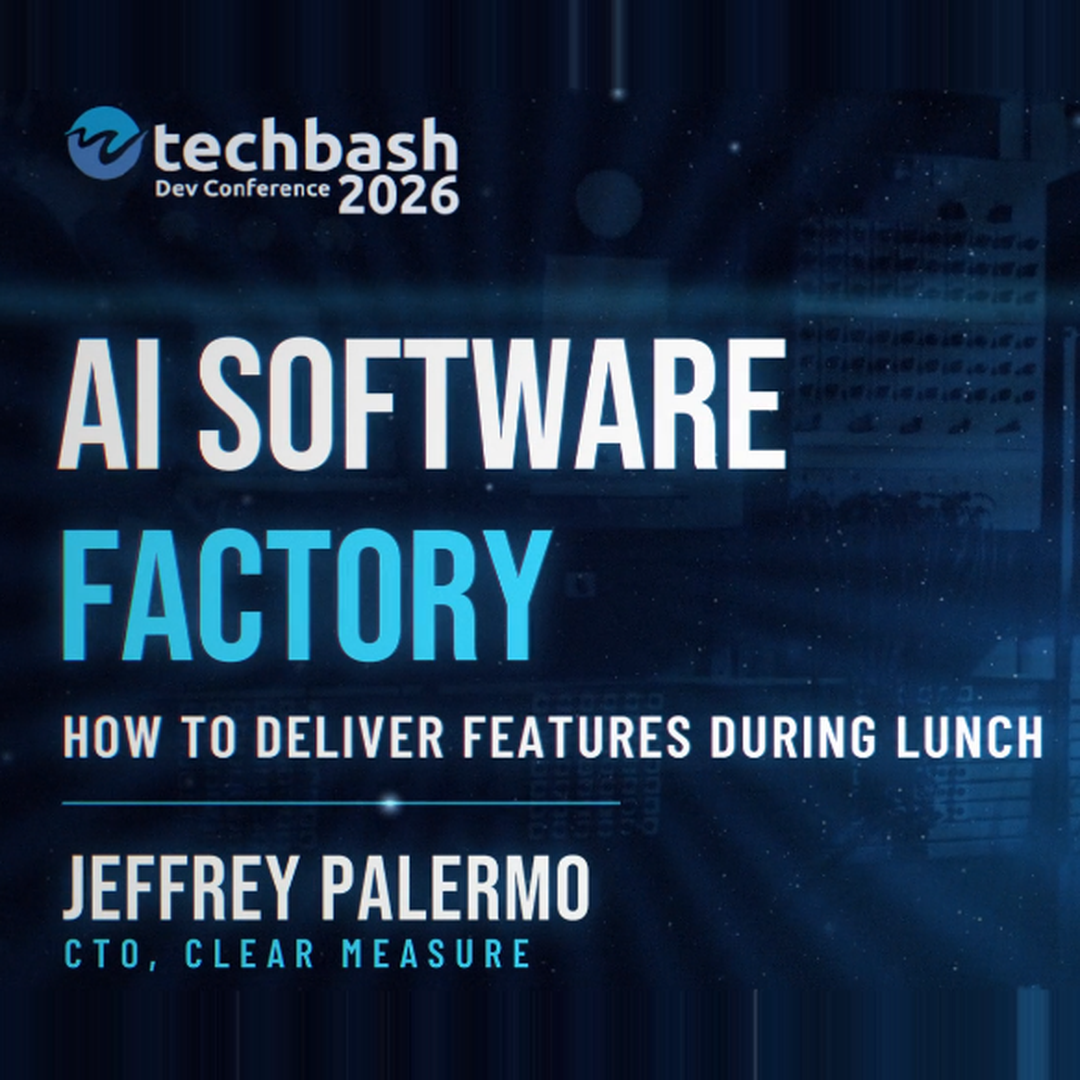
.NET AI Architecture for DevOps provides strategies and design patterns to enhance software development and deployment with AI integration. AI‑driven development is transforming how .NET engineers deliver software. Instead of envisioning a fully autonomous future, this webinar presents a practical, near‑term model: enabling a skilled engineer to compress a month of feature work into a single day through AI‑Driven Development. Jeffrey Palermo introduces an approach that pairs clear architectural decisions with high‑leverage automation and modern AI coding tools like Cursor, GitHub Copilot, and Claude. Attendees will learn how to design AI‑ready DevOps environment, use parallelized local and cloud runners, and guide LLMs to generate code, tests, and supporting artifacts with confidence and consistency. Implementing .NET AI Architecture for DevOps ensures consistent testing, scalable pipelines, and effective AI integration. The session covers how to structure a repeatable workflow for rapidly delivering production‑quality features—achieving 10× throughput without sacrificing quality or control.
Clear Measure has appointed Brad Clancy as Vice President of Sales, adding an experienced sales leader to support the company’s continued growth.  Brad brings extensive sales leadership and business development experience from firms including Accenture, IBM, Hewlett-Packard, EDS, and Cognizant. Across these organizations, he focused on opening new logo accounts while expanding buying centers within existing install base accounts.  He holds a B.A. from the University of Michigan, an Executive MBA from Michigan State University, and a Master of Science in Leadership from Capella University. He has also studied strategy through executive education programs at both Harvard and Wharton. Brad lives in Troy, Michigan, with his wife and golden retriever, enjoys spending time with his son and daughter, reading, and playing the trombone.  In his role as Vice President of Sales, Brad will lead Clear Measure’s sales efforts, working closely with clients and internal teams to strengthen partnerships and support long-term growth. His approach emphasizes customer service, responsiveness, and consistently putting the needs of Clear Measure’s clients and prospects first. 
“As a collaborative and inspirational leader, Brad combines his deep business acumen with industry strategy and technical expertise to empower teams and help others achieve their highest potential,” said N. Hansen, Fractional CIO and Globally Trusted Strategic Advisor, BizLogic LLC.    Steve Hickman, CEO of Clear Measure, said, “Brad brings a sales background rooted in large enterprise accounts, which aligns well with the market Clear Measure is targeting. His experience with major account buying processes, competitive differentiation, and enterprise sales strategy will be a strong asset as we continue to grow.”    “I am very excited to join Clear Measure for its unparalleled thought leadership in continually driving and bringing to our clients the latest best practices in custom software development and delivering a clear and measurable difference in resultant business outcomes,” said Brad. “I am also very thrilled to join this uniquely warm and highly collaborative culture.” 
Clear Measure is a full-service software architecture and engineering firm serving organizations using .NET and Azure. The company builds mission-critical custom software, rescues in-progress projects, and stabilizes systems that are not performing as expected.  Clear Measure’s work is guided by five pillars: create clarity, establish quality, achieve stability, increase speed, and optimize the team. Services include custom software development, upgrade and migration initiatives, project rescue and jumpstart efforts, fractional leadership, and software audits. Through this approach, Clear Measure empowers teams to move fast, build smart, upgrade skills, and achieve successful software project outcomes.  With Brad Clancy joining the team, Clear Measure continues to build on its commitment to strong client partnerships and long-term growth.     Reach out to Brad directly at brad.clancy@clear-meausure.com   
Many pundits compare AI to a junior developer on your team. This is false. AI is code that runs on a computer and cannot operate fully by itself. It must be operated like any other sophisticated machine. However, it is a very sophisticated machine capable of building software features if the development environment is well-designed and complete. This webinar will demonstrate the ability to fully delegate a software feature to an unmonitored AI tool. When an engineer reviews the output, it will be a fully developed feature that meets the team's standards, including all automated tests, and a complete pull request ready for review. Move into the future with us, where you can delegate the development of easy features and changes entirely to the computer, allowing your engineers to focus on new, novel, or difficult features.
AI-driven software isn’t about replacing engineers—it’s about amplifying their effectiveness. By letting computers generate significant portions of code, projects can move at the pace of your ideas while using fewer manual hours. Work that would take an average developer two weeks of coding can be reduced to a single day with AI-driven development. This shift allows teams to deliver features quickly and with fewer people—creating better economics than traditional offshore development while avoiding communication gaps or delays.    To make that speed count, teams need to create clarity—clear goals, shared priorities, and a visible path. When everyone knows what’s being built, why it matters, and how success is measured, AI becomes a real accelerator instead of just a code generator.    This combination of AI-driven development and clarity allows teams to deliver features faster, reduce rework, and maintain high quality.  AI at Work in Software Builds  When specifications, UX details, technical design, and test plans are clear, AI tools can produce large portions of functionality in seconds. Engineers then refine and validate that output, ensuring the resulting software matches your standards and integrates cleanly into your systems.    Creating clarity early in these steps reduces confusion and rework later. By structuring work into well-defined stages—concept, design, implementation, validation, release—teams ensure AI is applied where progress stands and where AI fits best.    Unlocking New Economics  Organizations often think that outsourcing offshore is the only way to save on development costs. AI-driven development offers a different path—enabling teams to produce code faster, streamline processes, and reduce expenses, while maintaining high quality and reliable outcomes.    Smaller, well-scoped projects make that advantage even stronger. When the team understands the purpose and outcomes, AI-accelerated work stays focused, predictable, and aligned with business goals.    Features, Delivered Sooner  This planned approach accelerates delivery while freeing developers to focus on high-value work: defining the right features, improving user experience, and strengthening overall design.  Measuring what matters—quality, stability, speed, and outcomes—keeps everyone on the same page and builds trust. With clear metrics, AI-driven development doesn’t just move faster; it moves smarter.    Key Takeaways 
  • AI-assisted coding accelerates development cycles. 
  • Tasks that once took two weeks can now be completed in a single day. 
  • Projects can be delivered with fewer people, improving cost efficiency. 
  • Early detection and refinement minimize rework. 
  • Faster builds unlock innovative, intelligent features for your software. 

Filters

The Five Pillars
The Five Pillars
Show more
Content Type
Content Type
Show more
Category
Category
Show more